Clock Drift Compensation
The internal clock of the INS has an accuracy of 20 ppm, it means that it drifts less than 1.7 s per day (72 ms per hour). This drift is linear except during the warmup period of the INS.
To fix this drift, feed the INS with time messages (typically $GPZDA sentences) but ensure that the external clock and the mechanism used to transmit time is more accurate than the INS clock itself. For example, if you try to resynchronize your unit with the time of a PC via a serial link, you can expect jitters in the transmission, the figure of the raw drift plot into Delph INS Subsea may look like the two following examples:
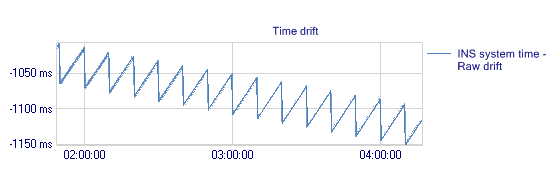
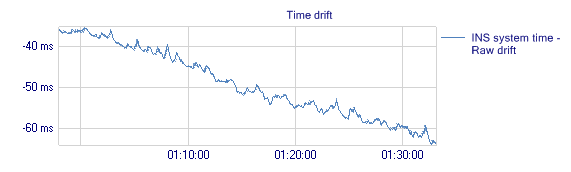
When the INS system time / Raw drift variable that you can plot from Delph INS Subsea does not look like a linear curve as below (rounded during warm up) it means that the external time is not accurate enough to resynchronize Delph INS Subsea:
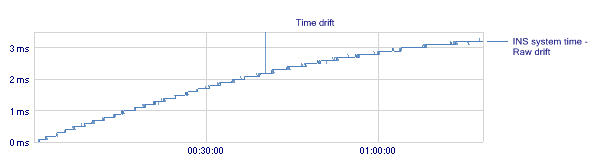
On this previous plot, the small stair case shape figures are normal since the resolution of time in the POSTPROCESSING file is 0.1 ms. We can observe also a spike at t=00:40:00, it will be filtered by Delph INS Subsea during the decoding of the file and the following warning is displayed:
WARNING: suspicious UTC data will not be used for clock drift compensation (simulation time 2421.73, utc time 2013/02/07 11:10:7.00).

|
In order to do a correct synchronization of your INS, you must use a PPS. If PPS is not used, do not try to compensate the INS clock drift using Delph INS Subsea (you have to do it later in your processing chain). |
During the decoding of the POSTPROCESSING, Delph INS Subsea informs about clock drift compensation:
INFO: INS synchronization method is 'time and PPS'.
{{ INFO: the drift of the INS clock is compensated using the UTC synchronization data.}}
The drift is automatically compensated when time synchronization is 'time and PPS'.
If the time synchronization is not automatically detected (old firmware) you may enable or disable manually the INS drift clock compensation mechanism.